In a time when space is becoming increasingly valuable and the demands on its use ever more complex, flexible furniture concepts for events and modern spaces are rapidly gaining importance. Whether for companies, educational institutions, hotels, or cultural events—the way spaces are designed, used, and continuously reinvented determines the experience, productivity, and long-term success. Instead of rigid structures, the focus today is on individuality, adaptability, and sustainable design. Those who want to stay ahead explore the new possibilities of this generation of furniture for demanding spaces and innovative event solutions.
Fundamentals and Trends of Flexible Furniture Concepts: Definition, Characteristics, Sustainable Materials, and Design Aesthetics
What exactly are flexible furniture concepts? They are furniture and interior solutions whose core features are transformability, modularity, and fast adaptability to different uses. Unlike conventional furnishings, these concepts allow for effortless transitions between work, lounge, or event areas—often in just a few movements. Innovative plug-in, folding, or sliding systems enable quick transformations without major structural changes, as seen in modular furniture in particular.
Sustainable materials such as recycled wood, metal, or durable high-tech fabrics are especially trendy today, offering both longevity and resource efficiency. Many manufacturers also rely on recyclable components and minimalist designs that look both functional and contemporary. Current color choices reflect a modern sensibility: natural tones and subtle accent colors create harmony in versatile environments. Comfort remains a priority. Seating and standing furniture are ergonomically developed and adapt to users and tasks alike. In this way, flexible furniture strengthens not only aesthetics but also the durability and environmental compatibility of interior spaces.
Planning and Implementing Modular Space Layouts: Ergonomics, Technological Integration, and Flexible Room Division
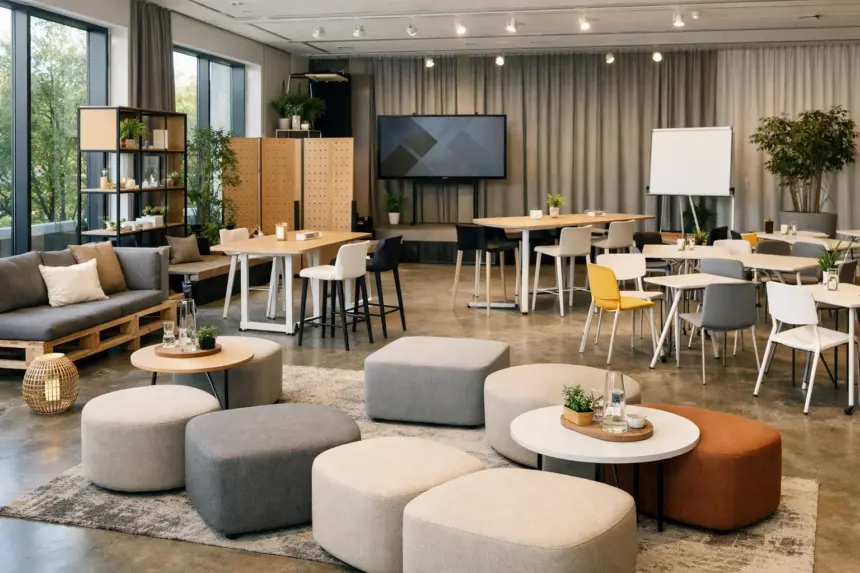
Planning a flexible spatial concept presents both unique challenges and opportunities. It is essential to consider modular elements early in the design phase so that living, working, or event spaces can quickly adapt to changing needs. Mobile partitions, stackable chairs, and multifunctional tables form the foundation for flexible layouts. However, simply rearranging physical elements is not enough—true innovation arises from the combination of ergonomics and smart technology. Coworking spaces are a prime example of flexible room concepts, where areas for relaxation, work, or events can be configured as required.
Intelligent furniture solutions now integrate USB ports, wireless charging stations, and digital controls directly into their design. Lighting scenarios can be customized, presentation technology seamlessly integrated, or climate zones individually adjusted. Event planners are advised to simulate movement flows and pre-design seating and standing zones. Ergonomic principles ensure comfort during frequent use—back-supportive seating positions, adjustable heights, and adaptable work surfaces are now standard in modern spatial planning.
Flexible Furniture Solutions for Events: Applications, Cost Efficiency, and Practical Concepts
What specific advantages do flexible furniture concepts offer for events? Flexible furnishings allow spaces to be repurposed within minutes. A conference area transforms into a workshop room, an exhibition stand becomes a get-together area, and a lounge opens into an auditorium. Clear favorites include modular stage systems, stackable chairs, mobile counters, and height-adjustable standing tables that can be combined or used separately depending on the occasion. A helpful overview of further products and practical solutions can be found at mein-stehtisch.ch.
From an economic standpoint, flexible furniture reduces overall event and investment costs because it is universally usable and highly durable. Fewer purchases are necessary, and intensive use across different events pays off quickly. There’s also a logistical advantage: lightweight, transportable elements save valuable time during assembly and disassembly, while storage and transport space requirements remain manageable.
Event planners also benefit from the variable layouts. Seating arrangements can be changed spontaneously, new participants integrated, or temporary partitions created as needed. Particularly popular are modular sofa elements that can be converted from traditional seating to a reception counter, as well as multifunctional room-in-room solutions that create acoustically shielded zones. The variety of modern furnishing concepts opens up new possibilities for designing events creatively and efficiently—always following the guiding principle: the space adapts to the event, not the other way around.
Conclusion: Future-Proof Planning with Flexible Furniture Concepts
In a world that is constantly changing and where spaces face ever-evolving demands, flexible furniture concepts for events and modern environments are key to sustainable, efficient, and creative design. They unite eco-friendly design, technological innovation, and economic efficiency to create experiential spaces that get the best out of every occasion. Investing in flexible furnishings means gaining freedom, individuality, and lasting value—a decision that pays off both ecologically and economically, shaping the future of modern space and event planning.