
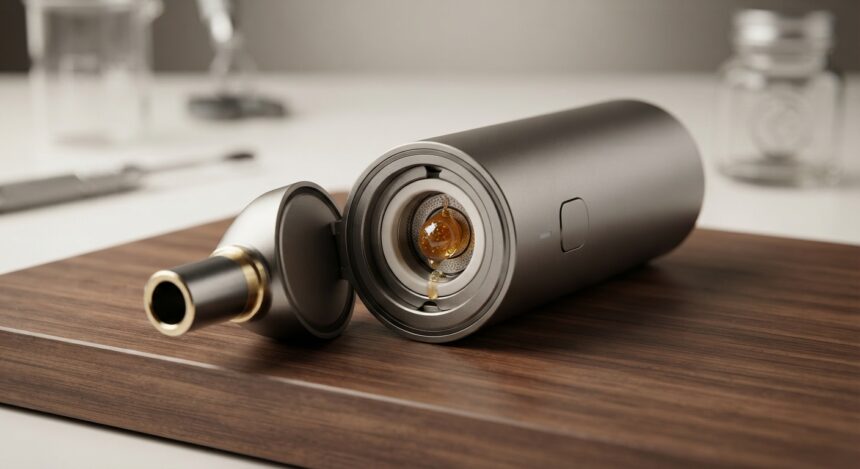
Anyone who wants to vaporize extracts quickly faces the question of which technique is even suitable for the job. Unlike plant material, concentrated substances behave completely differently under heat: they melt, change their consistency, and react sensitively to temperatures that are too high or too low. This is precisely where the challenge lies, because many classic devices are simply not designed for this purpose. In 2026, however, device technology has advanced significantly, so that more precise temperature control and specially adapted vaporizing chambers have now become standard. The following article explains what matters when vaporizing concentrates, which typical problems arise, and how these can be solved with the right equipment and approach.
What Sets Extracts Apart from Conventional Material
Extracts differ fundamentally from dried plant material because they come in a concentrated, often viscous or resinous form. While with loose material air flows through a chamber and heats the contained substances evenly, extracts require a surface or area on which they can melt and vaporize. This physical property means that devices originally designed for herbs often reach their limits with concentrates. The consistency ranges from wax-like to liquid, which additionally places different demands on the vaporizing surface. A contact area that is too small results in material being left unused, while an area that is too large loses heat unnecessarily quickly.
The Challenge of Heating Concentrates
The greatest difficulty lies in achieving a constant and precisely controllable temperature without destroying valuable flavor compounds in the process.
Temperature Sensitivity of the Active Compounds
Concentrates react considerably more sensitively to heat fluctuations than dried material. If the temperature is set too low, the substance barely vaporizes or does so incompletely. If it is set too high, the material partially burns, which leads to an unpleasant, burnt taste and at the same time destroys valuable terpenes. This delicate balance makes precise, stepless temperature regulation necessary, something that is often lacking in simple entry-level devices.
Material Loss Due to Unsuitable Chambers
Another common problem is material loss. Conventional vaporizing chambers are usually designed for loose herbs and have no suitable surface for viscous or wax-like substances. The concentrate runs down the walls, collects in hard-to-reach spots, or clogs ventilation openings. As a result, a noticeable portion of the material used is lost without ever having been vaporized.
Cleaning and Maintenance
Viscous residues are also considerably harder to remove than dry residues from plant material. Without regular cleaning, residues settle in channels and on heating elements, which reduces performance over the long term and impairs the taste of subsequent uses.
Solution Approaches for a Better Result
These challenges can be specifically solved with adapted technology and a well-thought-out approach.
Adapted Heating Systems and Chamber Shapes
Specially constructed chambers with smooth, heat-resistant surfaces ensure that concentrates vaporize directly and evenly instead of running off at the edges. Ceramic or quartz inserts have proven effective here, as they transfer heat quickly and evenly without imparting any taste of their own. This design delivers noticeably more intense aromas, as demonstrated by the example of a vaporizer for extracts, in which the chamber shape and heating system are specifically tailored to concentrated material.
Precise Temperature Control in Practice
A practical example illustrates the difference: if the temperature is increased step by step, starting at a low setting, you can observe how the material first melts and only vaporizes completely at a slightly higher level. Users who deliberately work through these levels report noticeably fuller aromas compared to a single, uniformly high temperature setting. Digital displays with exact degree settings make this process considerably easier, since deviations of just a few degrees are already noticeable in the taste.
Dosing the Amount of Material Correctly
The amount of concentrate used also plays a role. Too much material at once means that the heat is not distributed evenly and a portion remains unvaporized. Smaller, evenly distributed amounts, on the other hand, ensure more complete vaporization and at the same time reduce the cleaning effort.
Practical Tips for Everyday Use
For a reliable result, a fixed routine is recommended: before each use, the chamber should be checked for residues and cleaned if necessary, since even minor contamination noticeably affects the taste. A gradual increase in temperature instead of an immediate maximum value protects both the material and the flavor compounds. Anyone who regularly uses concentrates also benefits from interchangeable chamber inserts, which can be easily cleaned or replaced without having to dismantle the entire device. The storage of the material itself also plays a role: extracts kept cool and protected from light retain their consistency longer and can be dosed more evenly.
Future Developments and Implementation Strategies
The advancement of digital systems continues steadily in 2026 as well, presenting companies with new challenges as well as opportunities. In particular, the integration of modern technologies into existing business processes requires a well-thought-out approach in order to ensure long-term success. Many organizations are increasingly relying on automated solutions that can be seamlessly integrated into existing structures.
Technological Trends at a Glance
Current developments show that artificial intelligence is playing an ever greater role in optimizing workflows. Companies that adopt corresponding systems early on often gain a decisive competitive advantage. At the same time, the connection between different software solutions is gaining importance, allowing data flows to be organized more efficiently. Especially in the area of resource planning, it becomes clear how a modern ERP system can help to network all areas of a company with one another.
Practical Implementation in Everyday Business
When actually introducing new technologies, it is advisable to proceed step by step and to involve employees in the process early on. A successful implementation takes both technical and organizational aspects into equal account. In addition, companies should ensure that visible content in the digital space is optimally prepared, so that findability on the web remains guaranteed. Anyone who deliberately relies on search engine optimization measures here can significantly increase their reach and reach potential customers more effectively. The combination of technological innovation and strategic planning thus forms the basis for sustainable success in an increasingly digitalized market environment.
Frequently Asked Questions (FAQ)
Which temperature is best suited for vaporizing extracts?
A medium to slightly elevated temperature that is adjusted step by step generally delivers the best results, as it allows complete vaporization without burning the material. The exact setting depends on the consistency of the respective extract.
Why does material remain unused in some devices?
Unsuitable chamber shapes or rough surfaces often cause viscous material to stick to the walls instead of vaporizing evenly. Smooth, heat-resistant materials such as ceramic or quartz noticeably reduce this effect.
How often should the vaporizing chamber be cleaned?
Regular cleaning after just a few uses prevents residues from settling and impairing the taste of subsequent uses. With intensive use, cleaning after each application is recommended.