You have five days after moving in to report your new address to the Danish authorities. Miss that deadline and you’re stuck: no registration, no CPR number, no bank account, no health card. A move to Denmark rarely fails because of the transport. It fails because of the order of the steps.
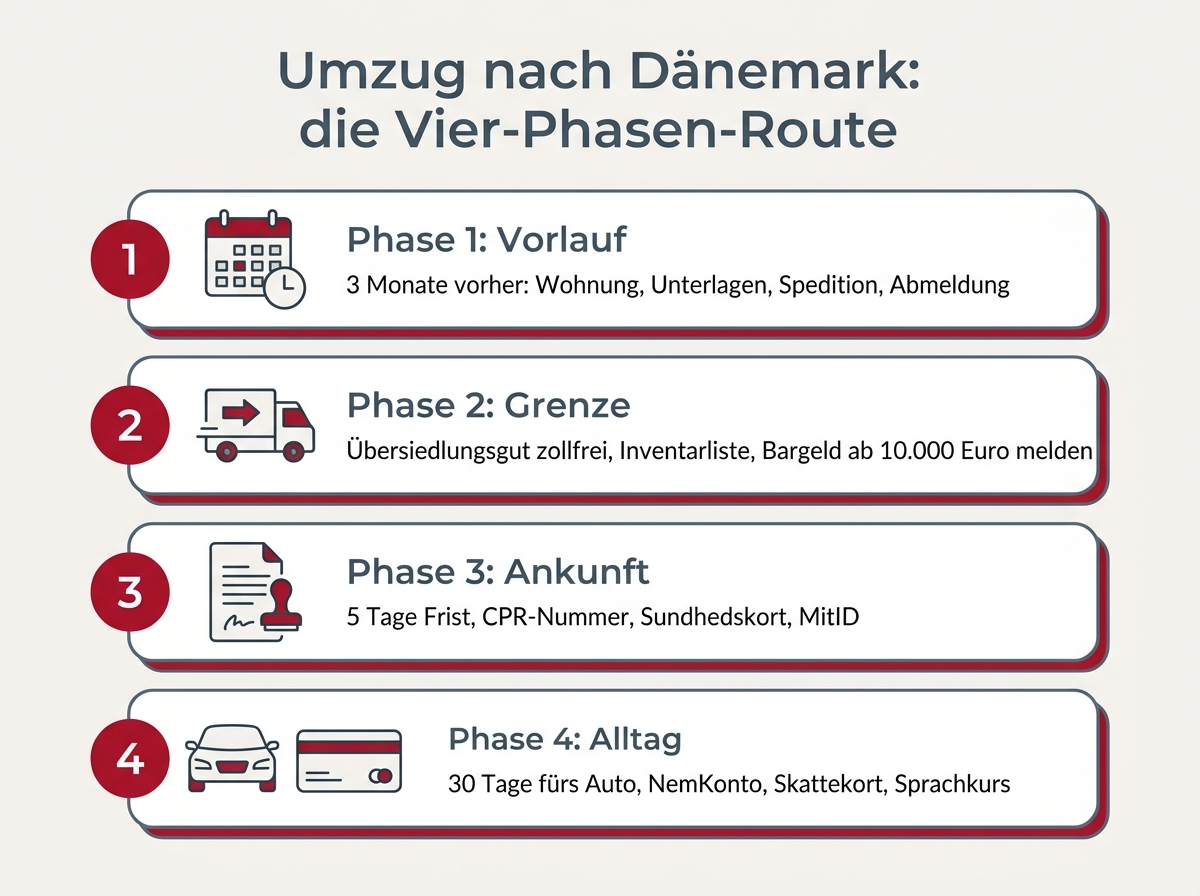
That’s why a fixed framework pays off. The four-phase route splits the change of residence into four stages that can’t jump the queue: run-up, border, arrival, everyday life. Each phase has a clear result, and at the end there’s a checklist to tick off. Planning ahead saves more money than any haggling over the price per cubic metre.
Why Scandinavia works differently from a move within Germany
Anyone moving from Germany to Denmark is switching to a country with a high quality of life and equally high prices. Denmark belongs to the EU and the customs union, but not to the euro area. You pay in kroner (DKK), and much of daily life is handled almost entirely online. Without the personal identification number from the Danish population register, practically nothing works. It’s tied to your home address, and your home address is tied to your tenancy agreement.
For EU citizens, entry itself is straightforward. A valid passport or ID card is enough, and no one needs a residence permit in the classic sense. Anyone wanting to live in the country for more than 90 days, however, applies for an EU residence document from the SIRI agency. That’s not a visa but a proof of status, and it’s usually the precondition for your CPR number application to be processed at all.
The second peculiarity: the country is small, and the housing market in Copenhagen and Aarhus is correspondingly tight. If you take the preparation as seriously as you would for a move to a major German city, you’ll spare yourself half the frenzy later on.
Phase 1: The three months before departure day
This is the phase in which all the important documents you’ll need later come together. Anything left undone here will block a whole stack of official errands in Denmark.
- Secure a home. Without a Danish address there’s no entry in the population register. Tenancy agreements often require a deposit of up to three months’ rent plus an advance payment. Your starting capital should therefore be higher than for a move within Germany.
- Obtain an employment contract or proof of income. Both serve SIRI as the basis for applying for the EU residence document.
- Bundle your paperwork. Passport or ID card, birth and marriage certificates, diplomas, vaccination record, driving licence, vehicle documents. Translations are rarely needed, copies almost always. These important papers should be scanned early.
- Enquire with a moving company experienced in Denmark. A firm that regularly runs the route knows the customs paperwork, the ferry dimensions and the route via Flensburg/Padborg or Fehmarn–Rødby; Der Umzugsprofi from Schleswig-Holstein, for example, specialises in precisely this connection, and a fixed price saves you the argument over waiting times at the border.
- Compare quotes. Three cost estimates should be enough to gauge the costs realistically. Pay particular attention to tolls, ferry fees and waiting times.
- Deregister at the German residents’ registration office. A separate deadline applies for a move abroad: at the earliest one week before moving out, at the latest two weeks afterwards (Section 17(2) of the Federal Registration Act).
- Cancel your contracts. Electricity, internet, broadcasting fee, clubs, insurance. The deregistration certificate serves as your proof.
An important note on health insurance: German statutory cover ends when you move away. Anyone working in Denmark automatically slots into the tax-funded system. For the period between departure and registration, a short travel health insurance policy is worthwhile.
Finding a home: the bottleneck before all other steps
Finding a place to live determines the timetable, because without an address nothing else can proceed. In the big cities, waiting lists for cooperative housing are common; in Odense or Aalborg things move faster. Many newcomers first rent on a fixed term and only look for something permanent once they’re on the ground.
On costs: the cost of living is noticeably above the German level, but salaries and social benefits are high. The cost of the transport itself depends on the volume, the route and the time of year. If you want to inform yourself early, the municipalities offer English-language information on tenancy law, deposits and utilities, so you can protect yourself against surprises.
Phase 2: Packing, customs and the drive across the border
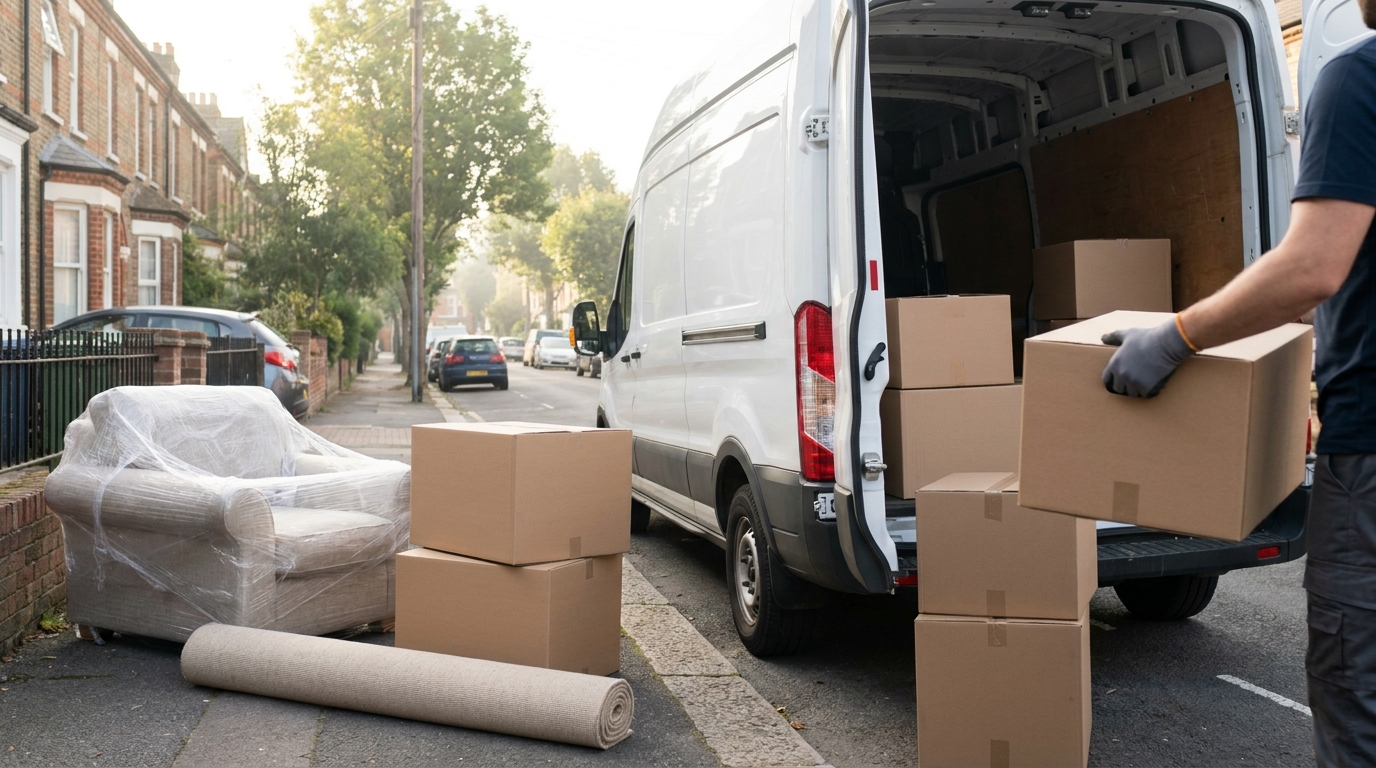
Household removal goods are duty-free when moving within the EU. Household effects, furniture and electrical appliances cross the border without charges, and no customs declaration is needed. Even so, there are three points where things can grind to a halt.
First, the inventory list. It isn’t formally required, but every moving company asks for it. During a spot check at the border near Padborg, it’s the only piece of paper that counts. Second, cash and valuables: anyone carrying more than 10,000 euros in cash, precious metals or securities must declare it to customs. Third, the special cases. Weapons, larger quantities of alcohol, plants and pets follow their own rules, which in many cases should be clarified in advance.
| Route | Distance | Typical for |
|---|---|---|
| E45 via Flensburg/Padborg | entirely by land | Jutland, Aarhus, Aalborg |
| Puttgarden–Rødby ferry | around 45-minute crossing | Zealand, Copenhagen |
| Storebæltsbroen | toll bridge | journey from Jutland to Zealand |
Anyone who has ever organised a move to a major port city like Hamburg knows the principle: no-parking zones, lift dimensions and delivery windows shape the day, not the distance. On top of that, many older buildings have narrow stairwells, so a furniture hoist should be factored in.
Phase 3: The first five days at your new home
Once you arrive in Denmark, things become binding. According to the official authority page lifeindenmark.borger.dk, a change of residence must be reported no later than five days after moving in. This deadline sets the pace for everything that follows.
Step by step, it goes like this:
- Book an appointment at Borgerservice with your tenancy agreement, ID and EU residence document.
- Receive your CPR number. Obtaining the CPR number is the single most important step: the number is ten digits, valid for life and opens every other door. The registration itself is free.
- Choose a GP. The assignment is made right at the appointment.
- Apply for the Sundhedskort. The yellow health card comes by post and replaces the German insurance card.
- Set up MitID. Without this digital identity you can neither run an account nor read mail from the authorities in Denmark.
In Copenhagen, Aarhus, Odense and Aalborg, the International Citizen Service brings several offices under one roof: registration office, SIRI and tax administration in a single morning. For newcomers, that’s the fastest option.
Phase 4: Car, account and taxes in the first few weeks
Four tasks remain, and three of them have their own deadlines.
The vehicle must be registered in Denmark within 30 days of moving there. This triggers the registration tax (“registreringsafgift”), which is based on the market value of the car and can reach substantial sums. For older cars, selling in Germany is often the cheaper option. That belongs on the calculator before departure day.
Running in parallel are your finances. Most people open a bank account right after receiving their CPR number; it becomes the NemKonto, the official account for paying out salary, tax refunds and benefits. And without a tax card (Skattekort) from the tax administration SKAT, your employer withholds the top rate, which really stings on your first pay slips.
That leaves the language. Many cities offer affordable Danish courses for newcomers. If you want to live and work in Denmark, English will get you through almost anywhere at work, but not in everyday life or at a parents’ evening. For an earlier start for professional reasons, language travel as a format for professional mobility is a good alternative to an evening class.
Frequently asked questions before you start
How long can you live in Denmark without registering?
As an EU citizen, up to 90 days. Anyone staying longer needs the EU residence document from SIRI. Once you’ve moved into a fixed address, the five-day registration deadline applies on top.
Are removal goods duty-free?
Yes. Denmark lies within the EU customs union, so used household effects remain free of charge. The only thing to note is the obligation to declare cash and valuables from 10,000 euros.
Can you pay with euros in Denmark?
Rarely. The official currency is the Danish krone. Payment is mostly by card and app, with cash playing a minor role.
Checklist to tick off
Three months ahead
- Home secured, deposit budgeted for
- Employment contract or proof of income in hand
- Document folder complete (ID, certificates, vehicle papers)
- Quotes from moving companies compared
Moving week
- Inventory list drawn up
- Deregistered in Germany, certificate received
- Contracts cancelled, mail forwarding order placed
- Route and ferry times set
First five days
- Registration done, CPR number received
- GP chosen, Sundhedskort applied for
- MitID set up
First few weeks
- EU residence document applied for at SIRI
- Vehicle re-registered within 30 days or sold
- NemKonto and Skattekort set up
- Danish course booked
Work through the four phases in this order and, after about two weeks, you’ll have your CPR number, account and tax card all together. From that point on, emigrating to Denmark is exactly what you pictured: a new home, not a filing procedure. And once you’ve managed to emigrate to Denmark without missing a single deadline, you’ve already got the hardest part behind you.