
In the second quarter of 2026, 17.1 percent of all U.S. retail sales happened online. Twenty years earlier that figure sat below 3 percent. One line in a Census Bureau report explains most of how digital marketing changed business: consumers moved, budgets followed, and companies that noticed early are the ones still growing.
Below: old and new side by side, seven shifts, each backed by a source, and a checklist for small businesses still running on word of mouth.
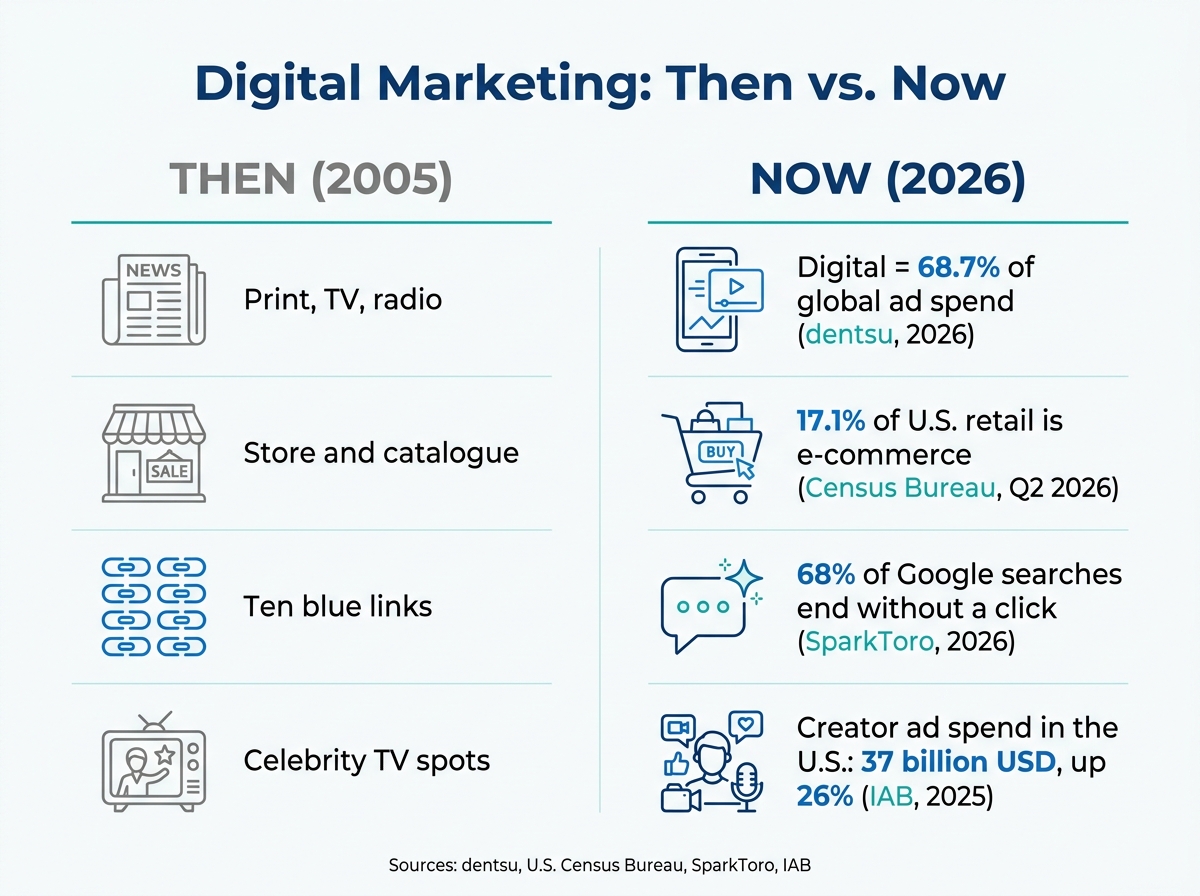
Then vs. now: marketing for businesses in one table
| Area | Then (around 2005) | Now (2026) |
|---|---|---|
| Main channels | Print, TV, radio, direct mail, trade fairs | Search engine, social media platforms, video, email, marketplaces, influencers |
| Ad budget split | Mostly offline; digital a side project | Digital takes 68.7 % of global ad spend (dentsu, Dec 2025) |
| Where customers buy | Store, catalogue, phone | 17.1 % of U.S. retail is e-commerce (Census, Q2 2026); 78 % of EU internet users shop online (Eurostat, 2025) |
| Targeting | Demographics of a magazine or a TV slot | Behavior and intent, first-party data, personalized messages |
| Measurement | Coupons, phone calls, gut feeling | Analytics, attribution, real-time dashboards |
| Speed | Campaigns planned months ahead | Tests launched, measured and stopped within days |
| Voice of the customer | Complaint letter, focus group | Reviews, comments, creator content, visible to everyone |
| Search | Ten blue links, clicks flow to websites | AI answers on the results page; 68 % of Google searches end without a click (SparkToro, 2026) |
Every row changes the way businesses find and keep their customers. Seven of these shifts deserve a closer look.
How digital marketing changed business: seven shifts with data
1. Ad budgets followed the audience online
The IAB/PwC Internet Advertising Revenue Report for full-year 2025, published in April 2026, counted 294.6 billion dollars in U.S. digital ad revenue, up 13.9 percent in a year without an Olympics or a presidential election to lift it. Social media alone brought in 117.7 billion dollars, or 40 percent, and search took another 38.8 percent.
For businesses, the meaning is plain: your brand competes for attention in a feed, a social feed’s comment section and a video player, and that auction runs around the clock.
2. The shop moved into the browser
According to the Census Bureau’s quarterly e-commerce report, U.S. online retail sales reached 340.2 billion dollars in Q2 2026, growing 12.2 percent year over year while total retail grew 6.7 percent. Europe shows the same demand: Eurostat reports that 78 percent of EU internet users bought goods or services online in 2025, versus 62 percent in 2015.
This is why marketing and sales have merged in many companies. A product page is a shop window, a checkout and a data source at once. How well that page and the payment step work decides the sale, as we described in e-commerce and digital payments: the three factors that shape the customer experience.
3. Search stopped sending clicks
For fifteen years the deal with Google was clear: publish useful content, rank well, receive visitors. That deal is fraying. SparkToro’s analysis of Similarweb clickstream data for January–April 2026 found that 68 percent of U.S. Google searches ended without a click, against roughly 60 percent in 2024. AI Overviews, answer boxes and Google’s own services absorb the rest.
Marketing strategies now serve two goals at once: still ranking in classic results, and being the source that AI answer engines quote. Clear facts, named authors and structured pages count more than a keyword density of 2 percent.
4. Data became first-party
Google’s plan to drop Chrome’s third-party cookies ended in April 2025, when the company said it would neither deprecate the cookies nor show a standalone choice prompt. Cookies survived, but the years of uncertainty changed behavior anyway. Marketers built email lists, loyalty programs and customer accounts so their targeting would not depend on a browser vendor’s mood.
Businesses with the best customer data, collected with permission, now run the most efficient campaigns. They can engage with their customers directly, personalize offers and measure results without renting a platform’s audience.
5. Influencers became a media channel
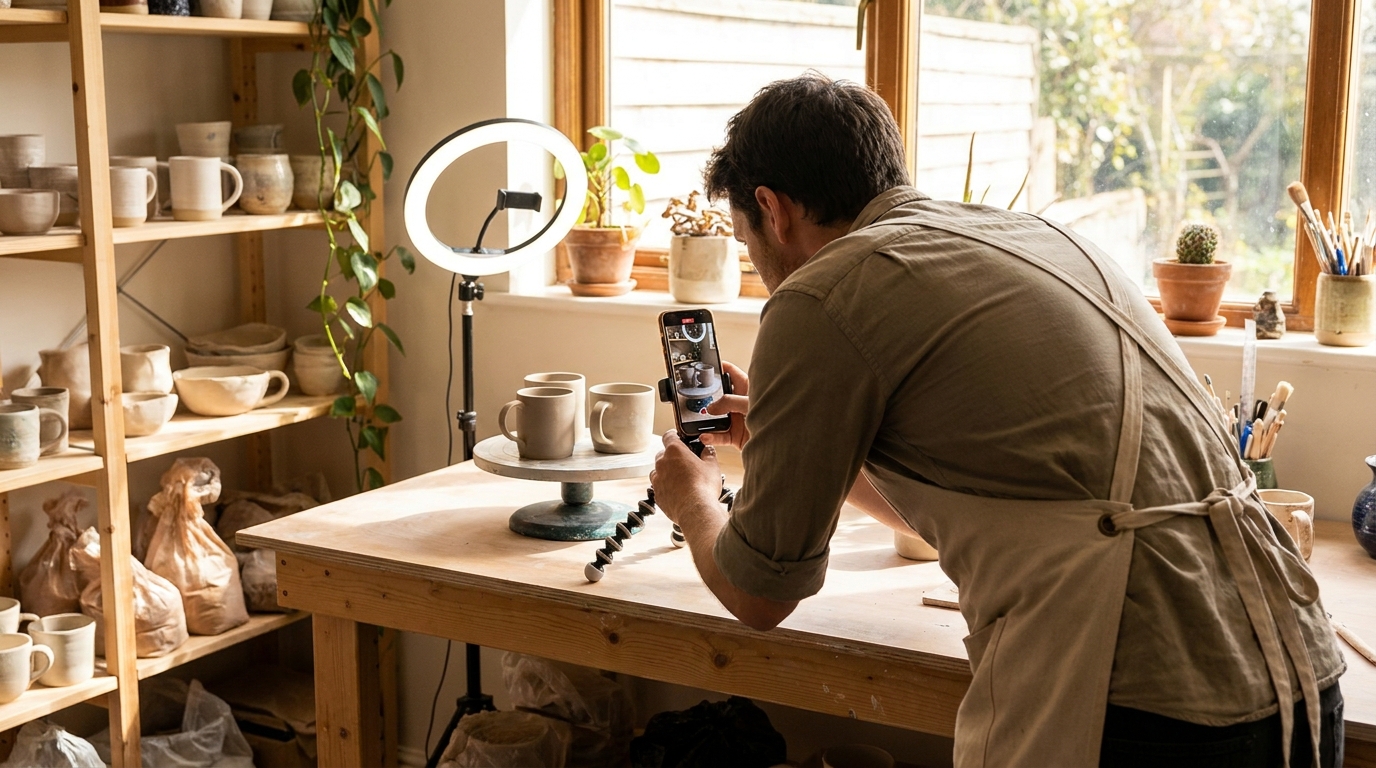
Influencer marketing used to be a PR experiment. In November 2025 the IAB projected U.S. creator economy ad spend at 37 billion dollars for 2025, up 26 percent, roughly four times faster than the media industry as a whole. Nearly half of the surveyed ad buyers (48 percent) call creators a “must buy” channel, and spend on creators has more than doubled since 2021.
Short-form video drives much of this, and it needs no studio. A plumber explaining a repair on TikTok or a bakery filming its morning shift on Instagram Reels reaches potential customers that a print ad in the same town never could. People’s attention has moved: Germans’ leisure activities are increasingly shifting to the internet, and brands build awareness where their audience spends its evenings.
6. Automation and AI run the routine work
HubSpot’s 2026 State of Marketing report says 80 percent of marketers use AI for content creation and 75 percent for media production, and 61 percent believe marketing is going through its biggest disruption in twenty years. Email sequences, ad bidding, product feeds and chat replies now run on software.
That changes staffing more than strategy. A two-person marketing team in 2026 can ship more campaigns than a ten-person department did in 2010, provided someone checks the output. The same wave has reached the back office, as seen in the digital revolution in payroll accounting.
7. Measurement replaced guesswork
The old joke was that half of the advertising budget was wasted, but nobody knew which half. Digital marketing has answered it. Cost per lead, return on ad spend and customer lifetime value are visible per campaign and per ad. Budgets shift weekly instead of yearly, and a campaign with weak engagement is switched off after a few days.
What small businesses can do now
These shifts favor companies that have data teams and large budgets. They do not exclude the rest. Small businesses can cover the essentials with this list:
- Own your customer list. Collect email addresses and consent at every touchpoint. It is the one asset no platform can take away.
- Fix the basics of your website. Fast loading, working mobile checkout, current contact details. Most lost sales die here, not in the ad.
- Write for answer engines. Put the direct answer in the first sentence of each section, name the author, keep facts and prices current.
- Claim your listings. Google Business Profile, Bing Places, Apple Maps and the directories your customers actually use.
- Post short video regularly. One honest clip a week beats a polished ad every quarter.
- Work with one or two local influencers who already talk to your target audience.
- Automate the boring parts: welcome emails, review requests, abandoned-cart reminders.
- Measure three numbers only: cost per lead, conversion rate, repeat purchase rate. Everything else can wait.
FAQ: how digital marketing has changed the way companies work
What is the biggest change digital marketing brought to business?
Measurability. Once every click, sale and return could be tracked, a creative expense became a managed investment with a visible return, and businesses can adjust their marketing strategies while a campaign is running.
Is traditional marketing still relevant?
Yes, for reach and trust. TV, outdoor and print still build a brand, and dentsu expects about 31 percent of global ad spend to stay offline in 2026. Most companies combine both; digital carries the measurable part.
How has AI changed digital marketing?
In two ways: as a tool inside marketing teams (content, bidding, analysis) and as a gatekeeper between businesses and consumers, when AI answers appear before any website link.
How does digital marketing differ from traditional marketing for a small business?
Budget flexibility and feedback speed. A campaign can start with a few hundred dollars, and results show up within days, so small businesses test and adjust instead of committing to a season-long print run.
What should a business do about zero-click search?
Accept that some traffic will not return, and build presence where the answer is shown: structured content, brand mentions, reviews, and your own channels like email and social media, where you can engage with customers without a middleman.