

By Friday lunchtime the last boxes are loaded; by eight o’clock Monday morning the team is sitting at the new location and carrying on as if nothing had happened. That is what a successful relocation looks like. And it looking that way has little to do with luck and a great deal to do with a handful of decisions made weeks in advance.
Most companies lose little time on the move itself to the transport. They lose it because the router isn’t delivered until Tuesday, because no one knew where the personnel files were supposed to go, or because the new address doesn’t appear in a single invoice template. That is precisely where good preparation comes in. The following seven levers show what matters in the planning stage and what belongs on every company relocation checklist.
Lever 1: Plan the Office Move Before the Lease Ends
The most common mistake happens right at the very beginning. The new lease is signed, the date is set, and only then does someone start doing the math. First check when you can actually get out of your old premises. For open-ended commercial leases the statutory notice period is around six months, but many contracts run for a fixed term of several years. Whatever the contract says trumps any rule of thumb.
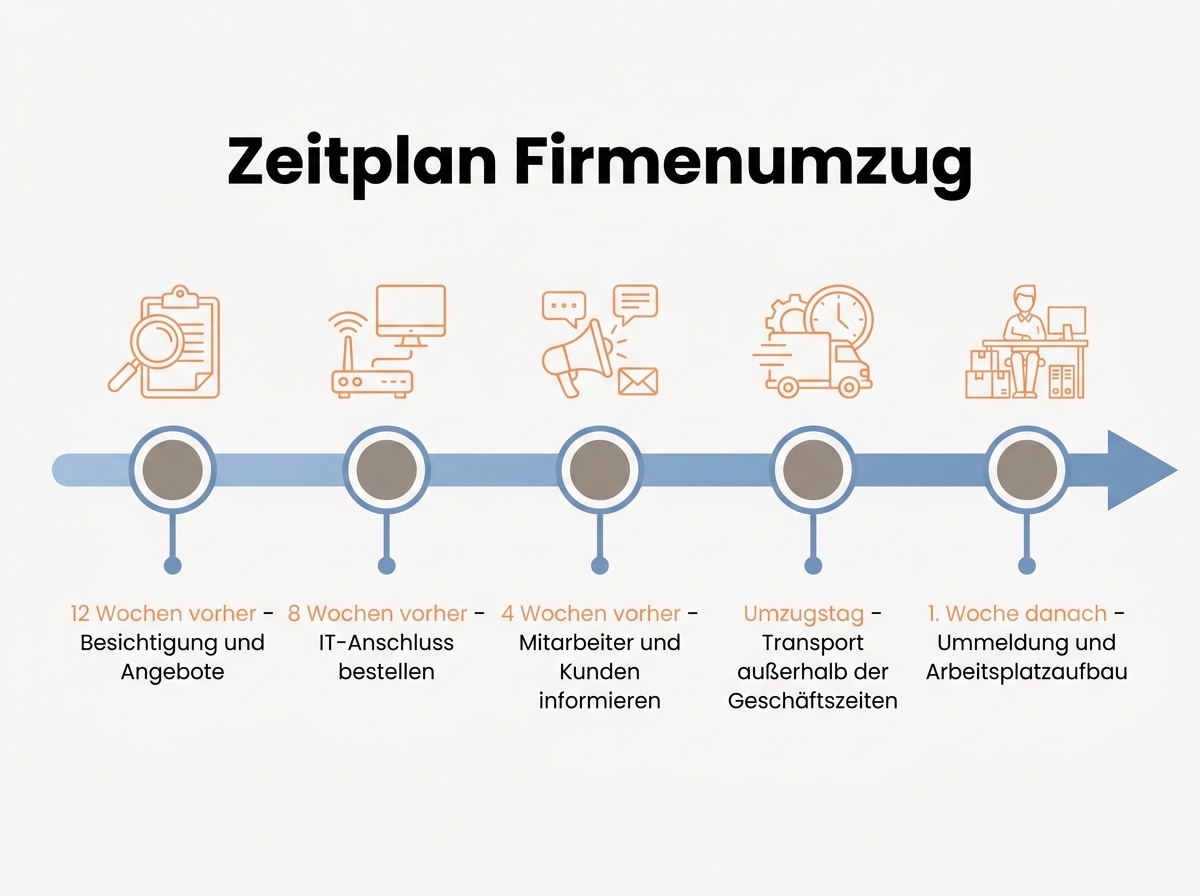
The organisation should be in place roughly twelve weeks before the date. Put responsibility in one pair of hands: a single person who keeps the overview, delegates tasks and is empowered to decide. This person draws up the checklist, tracks deadlines and serves as the point of contact for everyone involved. And they line up a professional moving company early. An experienced moving company such as a competent moving company in Hanover visits both properties before quoting, takes measurements, inspects the stairwell, lift and access route, and builds a coordinated schedule from all of it. A company move needs this site visit, because only then does it become clear how many people, how much material and how many hours the moving day will really cost. Anyone who looks for a service provider two weeks beforehand takes whatever is still available.
Three tasks belong in this first phase:
- Inventory: How many workstations, pieces of furniture, server cabinets and storage shelves are coming along? What gets sorted out?
- Budget with a buffer: Experience shows a small office move sits in the low four-figure range, while larger operations with specialised transports go well above that. Plan for a 15 to 20 percent reserve. For tax purposes, the costs of a business-related move are generally deductible business expenses.
- A sensible date: Friday plus the weekend costs less working time than a Tuesday. Apply for no-parking zones at the old and new addresses as early as possible.
Lever 2: IT and the Server Room Need Their Own Time Slot
Technology determines whether operations grind to a halt or keep running. A desk can arrive a day late; a dead internet line cannot.
Order the connection at the new location as early as possible. With fibre or a business connection, several weeks can easily pass between order and activation, and this date cannot be sped up once it has been missed. In parallel, IT clarifies whether servers physically move along or whether the move is the right moment to shift services into a data centre.
Organise the transport itself outside business hours. Servers, switches and the phone system move on Friday evening so that everything runs reliably on Monday. Four points that make the reassembly efficient:
- A full backup before dismantling, stored off-site. Restore it once as a test before the first cabinet is taken apart.
- Photograph and label every cable and every port. Otherwise the setup takes many times as long.
- Transport equipment in padded specialist crates rather than in boxes with packing paper.
- A test run on Sunday: network, printers, telephony, access to the ERP. This ensures that no one is sitting in front of a dead screen on Monday.
Anyone using the move as an opportunity to streamline processes anyway will find useful food for thought in this article on lean processes and the fight against waste.

Lever 3: Files Move in Sealed Containers
Personnel files, contracts, customer data: as soon as personal data is involved, the move is a processing operation like any other. Art. 32 GDPR requires appropriate technical and organisational measures. In the day-to-day reality of a move, that means something quite concrete:
| What | How |
|---|---|
| Transport | Sealed, numbered containers instead of open boxes |
| Proof | Handover protocol with container numbers, signed on release and receipt |
| Service provider | Data processing agreement under Art. 28 GDPR if access to personal data is possible |
| Interim storage | A lockable room with documented access |
A move is also the best time to clear out, though not by gut feeling. For tax and commercial-law purposes, retention periods of up to ten years must be observed, for example for commercial ledgers, annual financial statements and accounting records. You can read up on this directly in § 257 HGB, supplemented by § 147 AO. Whatever really can go is securely destroyed in accordance with DIN 66399 rather than tossed into the paper container. For ordinary business documents, security level P-4 is usually specified; for sensitive personnel data, a higher one.
A small side effect: less paper means less transport volume, and that feeds straight through to the price.
Lever 4: Inform Employees and Customers in Good Time
A relocation changes each individual’s commute, lunch break, sometimes the childcare arrangement. Anyone who informs employees only four weeks in advance by group email reaps resistance that has nothing to do with the move itself. What matters, then, is this: give notice early, as soon as the decision is final, and also name what is still open. After that, a brief, regular status update is enough.
Clarify these points in good time as well:
- Who packs their own workstation, and who receives support?
- Is there working from home, leave or a requirement to be present on moving day?
- What does the seating arrangement in the new office look like, and who decides on it?
- Which routes change; is there a transit pass, parking spaces, bicycle racks?
It is best to inform customers and suppliers in two stages: an announcement about four weeks in advance, and a brief confirmation as soon as you are up and running at the new location. If the business is growing alongside the move, it is worth looking at how growth and staff organisation interact. A move amplifies every organisational weakness that was already there beforehand.
Lever 5: Update the New Address Everywhere
This task is unspectacular and yet often underestimated, because it consists of thirty small steps. Authorities first:
- Trade office: re-registration under § 14 GewO, usually subject to a fee.
- Commercial register entry: for registered companies, the change of registered office goes through the notary.
- Tax office: jurisdiction may change when moving to a different municipality.
- Chamber of Industry and Commerce or Chamber of Crafts, employers’ liability insurance association, insurers: your business liability and contents insurance should also know the new place of business.
After that, update your own external presence: legal notice, Google Business Profile, letterheads, invoice templates, email signatures, stamps, vehicle lettering and every page of your own website where the old address appears. A mail forwarding order for business post catches whatever gets forgotten anyway, and everyone forgets something. Reckon on a term of at least six months.
Lever 6: Set Up Workstations Instead of Dumping Furniture
The same rules apply at the new location as at the old one. Germany’s Workplace Ordinance sets requirements for room size, lighting, escape routes and screen workstations. So already during the site visit, check power sockets, network outlets and lighting conditions, and work out whether the escape-route width still holds up once the filing cabinets are in place.
For furnishing the new premises, a floor plan helps enormously. Each room gets a number, and each box and piece of furniture gets a label with that number. The moving team then sets everything down in the right place without asking, and no one spends Monday shifting cabinets around. Anyone refurnishing anyway will find inspiration in flexible furniture concepts for modern spaces for bespoke areas that can later be used in yet another way.

Also on the list: a handover protocol for the old premises with photos of pre-existing damage in the stairwell, final cleaning, key handover, meter readings. That costs an hour and saves four-figure sums in the event of a dispute.
Lever 7: The Mistakes That Make Every Relocation Expensive
Four patterns keep cropping up in practice.
Started too late: connection dates, official deadlines and good removal slots cannot be made up later. Twelve weeks is the minimum; six months is comfortable.
No clear responsibility: a move for which five departments are jointly responsible gets stuck on the details. A named person with decision-making authority and a genuine time budget costs little and saves the most.
Insurance not checked: the removal company’s liability is capped by law and rarely covers high-value technology in full. Transport insurance for moving day is quickly arranged.
Everything at once: a move, a software changeover and a new phone system in the same month is something you shouldn’t even consider. Defer whatever can be postponed.
How far in advance should you plan a company move?
Twelve weeks is considered the lower limit; for larger operations with a server room and many workstations, six months is realistic. The limiting factor is rarely the transport, but the notice period and the activation of the data line.
Which authorities must you inform about a change of location?
The trade office, the tax office and, for registered companies, the commercial register via the notary. Add to that the chamber, the employers’ liability insurance association and the insurers.
How do you correctly transport files containing personal data?
In sealed, numbered containers, with a handover protocol and, if the commissioned company could gain access to the data, with a data processing agreement.
How to Get Moving
Take two hours this week and get three things done: look up the notice date in your old lease, order the connection at the new location, and arrange two site visits with removal companies. The checklist, floor plan and address changes can then be worked through at your leisure. But these three points determine whether the Monday after the move is spent working or searching.