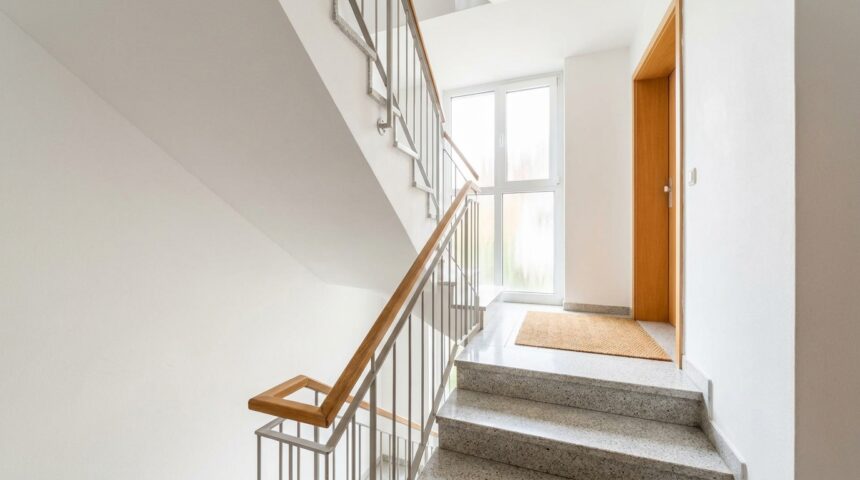
A note is taped up in the hallway: “Clean the stairs, 2nd floor is up!” Beneath it, a signature no one can decipher. Notes like these surprisingly often spark a full-blown neighbourly dispute, and most of the time the parties are arguing over assumptions that don’t hold up legally at all. Stubborn half-truths cling to stairwell cleaning, among tenants and landlords alike. Who has to clean? Who pays the company? And who’s liable when someone slips on a damp step? Six of these myths turn up in almost every building. Here they go under scrutiny, one by one.
Myth 1: “The landlord cleans the stairwell anyway”
The starting point is correct. Under § 535 of the German Civil Code (BGB), the landlord owes the tenant a rental property in a contractually agreed condition, and that includes stairs, hallways and the entrance area. Without a specific agreement, cleaning the stairwell remains the landlord’s job. All that’s wrong is the little word “anyway”: the landlord is allowed to transfer stairwell cleaning to the tenants, and in standard-form leases he almost always does.
What matters is how. A clause in the lease must explicitly name the duty to clean the stairwell, and its scope must remain recognisable to the tenant. A bare sentence like “The tenant cleans the stairwell” is an invitation to dispute. A solid clause, by contrast, defines four points:
- Areas: staircases, landings, hallway, cellar stairs, building entrance, often window sills and railings too
- Frequency: weekly, every two weeks, more often in heavily used buildings
- Order: which tenant is up when, and who stands in when someone is ill or on holiday
- Materials: who provides the mop, bucket and cleaning agents
A notice on the bulletin board does not replace this agreement. And house rules only oblige the tenant to clean if they have effectively become part of the lease. As a one-sidedly added annex, house rules are generally not enough. Anyone who has just moved in is best advised to read the clause during the contract walk-through, together with the other duties surrounding your first apartment.
Myth 2: “A cleaning company only pays off from twenty units”
Cleaning by the tenants themselves rarely fails because of the building’s size, but it does fail on reliability. In a six-unit building with shift workers, small children and two long-distance commuters, the finest cleaning schedule collapses after a few months. Then the score-keeping begins: which tenant skipped their turn, who only dry-swept, who never touched the cellar?
Anyone who instead wants to hire a cleaning company is mainly buying a fixed schedule. Service providers such as NordKlar Gebäudereinigung Hamburg come on agreed days, work with consistent products and document the cleaning work carried out. The debate over whether the landing on the third floor really was mopped comes to an end. For many owners this counts for more than the price, because stairwell cleaning no longer depends on a residents’ community that tears itself apart over it. The fact that the costs of stairwell cleaning can usually be passed on to the tenants makes the maths all the more manageable. More on that shortly.
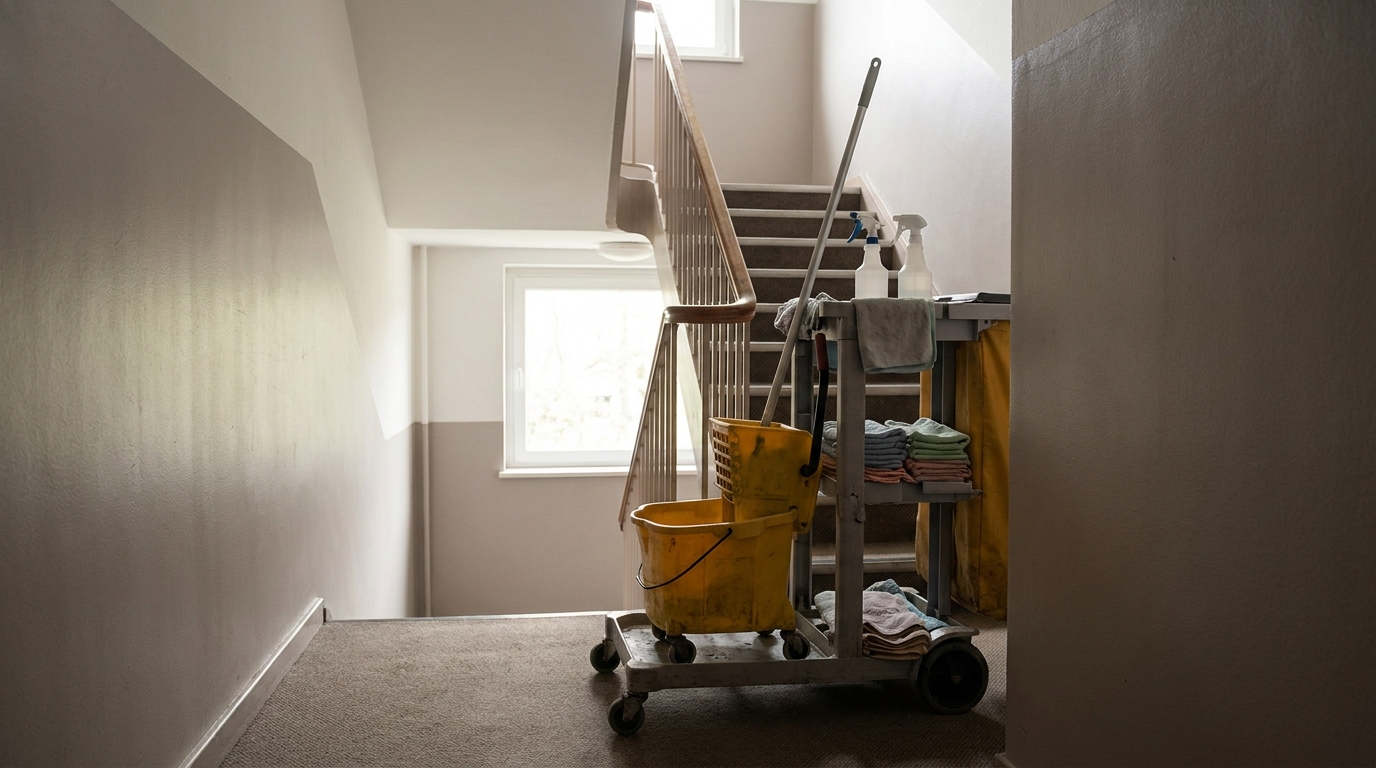
Even in a small building the contract can pay off if it’s leanly tailored: short intervals on the ground floor, wider gaps on the upper floors, windows and deep cleaning only twice a year. If a caretaker is engaged for the cleaning work, the same rules apply to the billing.
Myth 3: “The owner pays the cleaning company’s invoice”
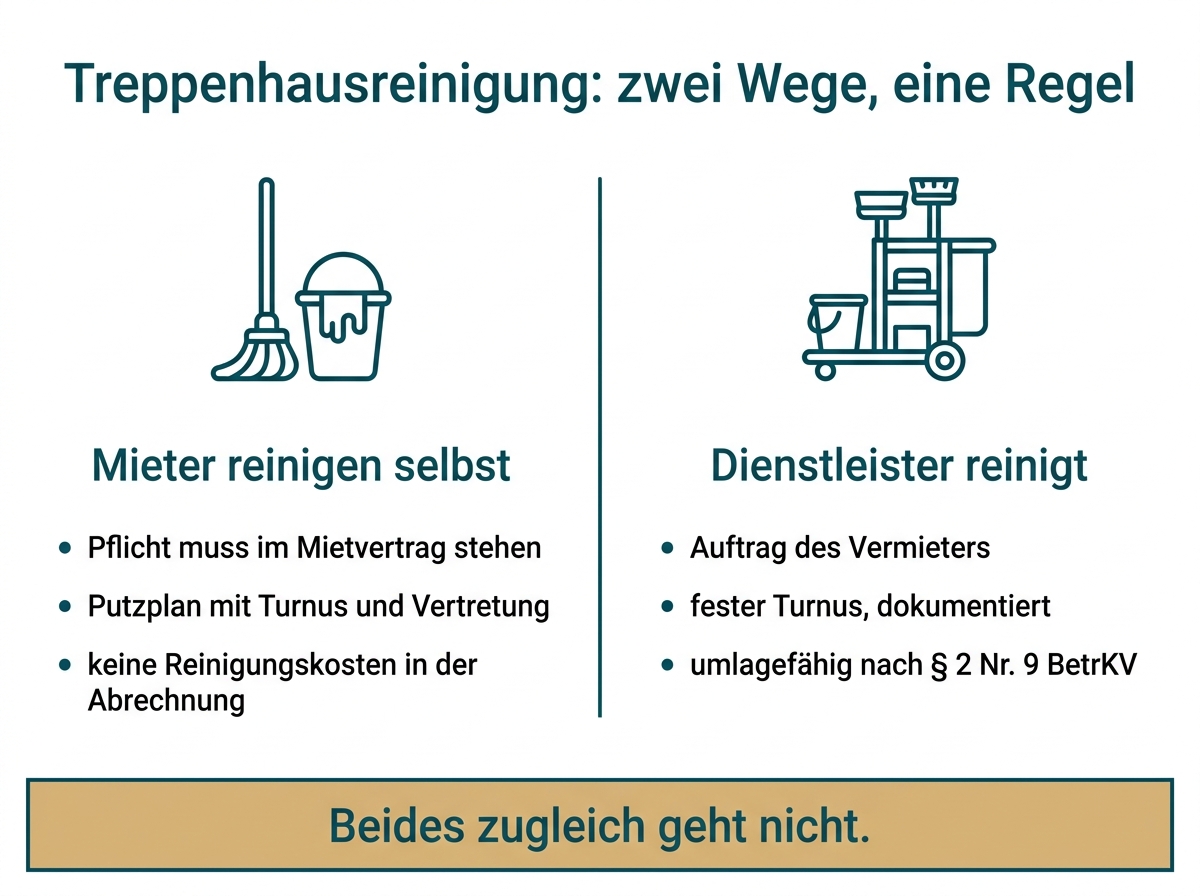
In the end it’s usually the tenant community that pays. The costs of building cleaning can be passed on as operating costs under § 2 No. 9 of the Operating Costs Ordinance. The ordinance explicitly names the parts of the building used jointly by the residents, such as access ways, hallways, stairs and cellars. Two conditions must be met: the lease must provide for operating costs to be passed on, and the duty to clean must lie with the landlord.
That second point is one both landlords and tenants like to overlook. You can’t have both at once. If the tenant is contractually obliged to clean the stairwell himself, no cleaning costs may appear in his service charge statement. Conversely, the landlord may not simply hand the task to a company during an ongoing tenancy and pass the resulting costs on to the tenants after the fact. That requires a change to the contract, meaning the tenants’ consent.
| Tenants clean themselves | Service provider cleans | |
|---|---|---|
| Basis | Tenant’s cleaning duty agreed in the lease | Landlord’s contract plus pass-on agreement |
| Service charge statement | no building-cleaning item | passable on under § 2 No. 9 BetrKV |
| Common point of dispute | frequency, cover, quality | level of costs, principle of economy |
Myth 4: “Ignore the cleaning schedule and you’ll be evicted”
It doesn’t happen that fast. Before any consequence comes the formal warning: the landlord must name the breach of duty specifically and demand that it be remedied. If still nothing happens, substitute performance is the usual measure. The landlord then has the cleaning work done by a hired hand and can invoice it to the defaulting tenant, not to the whole residents’ community.
Termination under § 543 BGB requires a serious, ongoing breach of contract. A forgotten cleaning turn during the summer holiday won’t carry it. A stairwell left filthy for months despite repeated warnings may carry it in an individual case. Proportionality decides, and in case of doubt it decides in favour of keeping the home. Anyone working through listings and comparing their next lease should therefore take the stairwell-cleaning clause more seriously than the question of tile colour.
Myth 5: “The landlord is always liable for a fall on the wet stairs”
The duty to maintain safety on the property lies first with the owner, or landlord: lighting, handrail, non-slip steps, clear escape routes. This duty can be transferred to tenants or to a service provider, but it does not disappear in the process. The landlord must select carefully and check whether cleaning and clearing are actually being done. The Federal Court of Justice (BGH) has also made clear that a landlord who is contractually bound to maintain safety is answerable for the fault of his vicarious agents as for his own.
For everyday life in the building this means:
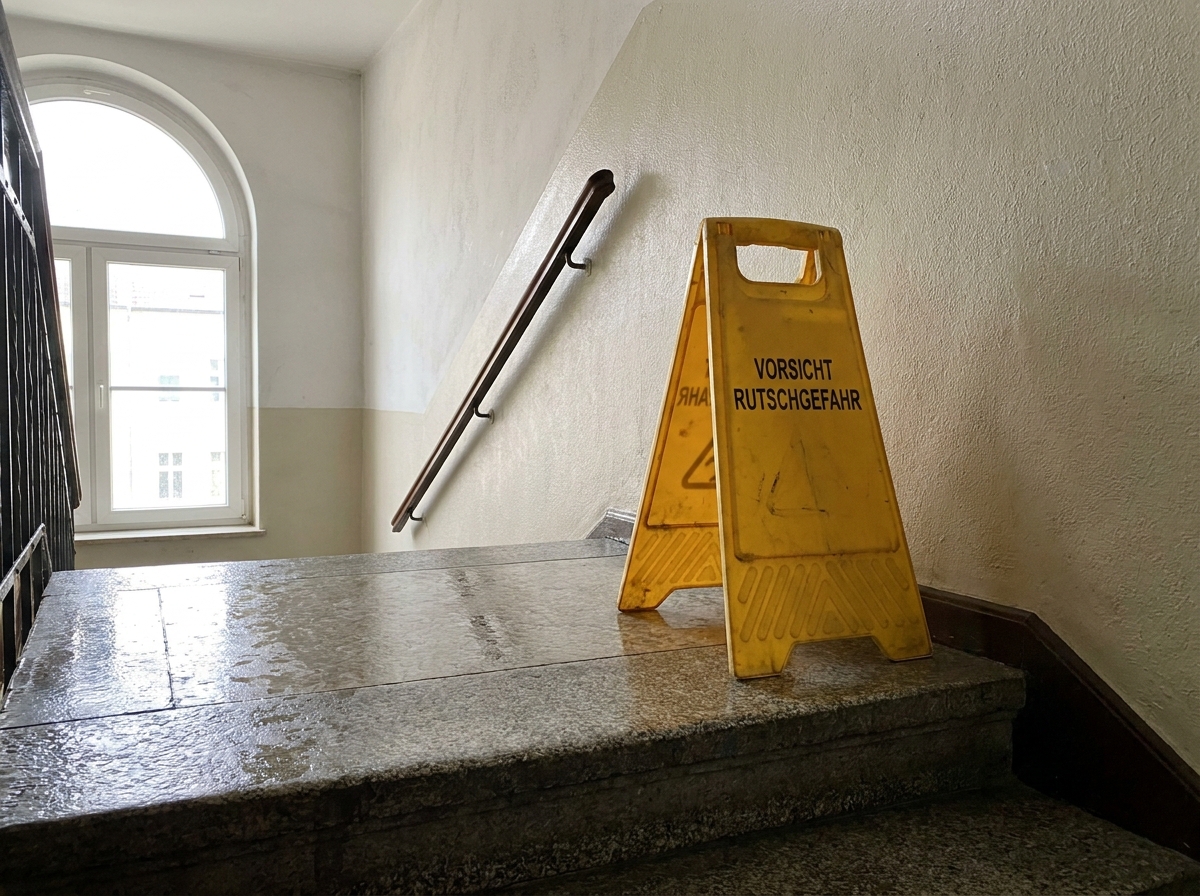
- When mopping, put up a warning sign or work section by section so a dry side stays walkable.
- No loose runners, no boxes and no bicycles on landings and staircases.
- Report faulty lights and wobbly railings immediately, not just at the next cleaning slot.
Anyone who, despite the wet floor and warning sign, hurries up two steps at a time must accept a share of the blame. A fall in the stairwell rarely has just one party responsible.
Myth 6: “The cleaning rota and winter service are part of stairwell cleaning”
The Kehrwoche (weekly cleaning rota) is a regional custom, above all in Baden-Württemberg, where it was historically even written into police ordinances. Legally it is a cleaning duty agreed in the lease that has its own name, often complete with the famous sign that wanders from apartment door to apartment door. In Hanover or Leipzig the very same thing is simply called a cleaning schedule.
Winter service, by contrast, is a duty of its own. Clearing and gritting the pavement and building access follows the municipal by-law, not the stairwell cleaning schedule, and appears in the statement as a separate item. So a tenant obliged to clean the stairwell does not automatically have to shovel snow. That requires a separate agreement.
The situation is similarly clear with bulky waste. A discarded shelf in the hallway is not a matter for the cleaning schedule but for whoever left it there. So during a bigger clear-out of your own apartment, it’s worth checking the collection date before the boxes narrow the escape route for weeks.
Three questions that keep coming up
What does stairwell cleaning include?
The usual tasks are sweeping and mopping the stairs and landings, cleaning the railing and handrail, the building entrance including the doormat, and the cellar stairs. Window cleaning and deep cleaning are extra services and are only included if the lease explicitly names them.
How often does the cleaning have to be done?
That is set by the lease or the house rules. A weekly rhythm is the common example in residential buildings; with heavy use, commercial premises in the building or in winter, the frequency may be tighter.
What does professional stairwell cleaning cost?
The cost of stairwell cleaning depends on the area, number of floors, frequency and travel, so a flat price is disreputable. In the service charge statement the cleaning costs appear as building cleaning and are distributed among the tenants according to the agreed key.
The key points in brief
- Without an agreement in the lease, cleaning the stairwell remains the landlord’s job (§ 535 BGB).
- Transferring it to the tenants only takes effect if areas, frequency and cover are recognisably regulated. A notice is not enough.
- A company’s costs can be passed on as building cleaning under § 2 No. 9 BetrKV, as long as the tenants aren’t cleaning themselves anyway.
- In the event of breaches, the order is formal warning, substitute performance and, only at the very end, termination.
- The duty to maintain safety remains with the landlord, even when he hands over the work. Selection and monitoring are part of it.
- Winter service is not part of stairwell cleaning; it needs its own agreement in the lease.
*This article provides general information on tenancy law and is no substitute for legal advice in an individual case.*