
Almost every patient who considers a “boob job” starts with the same two worries: what will it cost, and how safe is it? This guide covers breast augmentation costs and risks one question at a time, using fee data from the American Society of Plastic Surgeons (ASPS) and safety information from the U.S. Food and Drug Administration (FDA).
*Medical disclaimer: This article is general information, not medical advice. It cannot account for your personal health history. Decisions about breast augmentation surgery belong in a consultation with a board-certified plastic surgeon.*
How much does breast augmentation cost?
According to the most recent ASPS procedural statistics (2023 data), the average cost of breast augmentation with implants is $4,875 for the surgeon’s fee, and $5,719 for augmentation with fat transfer. That average is only part of the bill. ASPS states plainly that it excludes anesthesia, the surgical facility and related expenses.
Once those are added, US clinic price guides published in 2025 and 2026 typically quote $6,000 to $12,000 for the procedure. The cost of breast augmentation varies widely by country, city and clinic, and a low headline price abroad can hide travel, follow-up and revision costs.
A complete breast augmentation quote usually includes:
- Surgeon’s fee (the ASPS figure above)
- Anesthesia fee, charged by the anesthesiologist or nurse anesthetist
- Surgical facility or operating room fee
- The implants themselves (silicone costs more than saline)
- Pre-operative tests, prescriptions and a post-surgical support bra
- Consultation fee, sometimes credited toward surgery
- Follow-up visits and, in some practices, a revision policy
Adding a breast lift raises the total, because augmentation with lift is a longer surgical procedure. Most health insurance plans do not cover cosmetic breast augmentation, and many will not cover complications from it either. Ask about that gap before you sign.
Which implant type is right for me: saline, silicone or fat transfer?
Each option changes the price, the feel and the long-term follow-up. This is the comparison most surgeons walk through at your first consultation:
| Option | What it is | Feel and look | Cost and follow-up |
|---|---|---|---|
| Saline implants | Silicone shell filled with sterile salt water | Firmer; rippling may show in thin patients; a rupture is obvious because the breast deflates | Lowest implant cost; FDA-approved for augmentation from age 18 |
| Silicone gel implants | Pre-filled cohesive gel; “gummy bear implants” are the firmest version | Softer, closer to natural breast tissue | Higher implant cost; FDA recommends routine imaging because ruptures can be silent; approved from age 22 |
| Fat transfer | Your own fat, taken by liposuction and injected into the breast | Most natural, but modest increase (often up to one cup size) | Higher average cost (ASPS: $5,719); some fat is reabsorbed; no device to maintain |
Cup size is not a unit surgeons work in; implants are measured in cubic centimeters (cc), and larger implants carry a higher chance of later revision.
What does the FDA boxed warning actually say?
Since 2021, the FDA has required breast implant labeling to carry a boxed warning, its strongest warning category for a medical device. The FDA’s breast implants information page sets out the points every patient should read before surgery:
- Implants are not lifetime devices. The longer you have them, the greater the chance of complications, and many patients will need additional surgery.
- BIA-ALCL. Breast implant-associated anaplastic large cell lymphoma is a cancer of the immune system, not breast cancer. It is linked mainly to textured implants. ASPS puts the lifetime risk with textured implants between 1 in 2,207 and 1 in 86,029; caught early, it is usually curable by removing the implant and the surrounding capsule.
- Systemic symptoms, often called breast implant illness (BII). Some patients report fatigue, joint pain, “brain fog”, rashes or memory problems. The FDA says these symptoms are poorly understood and can occur with any implant type.
- Follow-up imaging for silicone implants. The FDA recommends an ultrasound or MRI five to six years after surgery and every two to three years after that, even without symptoms, because silicone ruptures can be silent.
The FDA also requires a patient decision checklist that you sign before the procedure. Read it slowly.
What are the other risks of breast augmentation surgery?
Beyond the boxed-warning items, your breast augmentation carries the general risks of any surgical procedure plus some specific to implants:
- Capsular contracture: scar tissue tightens around the implant, making the breast hard or painful; the most common reason for revision surgery
- Infection, bleeding or fluid collection (seroma)
- Changes in nipple or breast sensation, which can be permanent
- Implant rupture, deflation, rotation or visible rippling
- Interference with mammograms, which need extra views when implants are present
- Difficulty breastfeeding; some women can, some cannot
- Anesthesia reactions and, rarely, blood clots
Revision surgery deserves its own line in your budget: implants age, so a realistic plan includes at least one more operation over a lifetime.
How long does recovery take?
ASPS notes that acute pain usually settles within one to five days and that soreness and swelling can last a few weeks. Most patients go home the same day and wear a support bra around the clock at first.
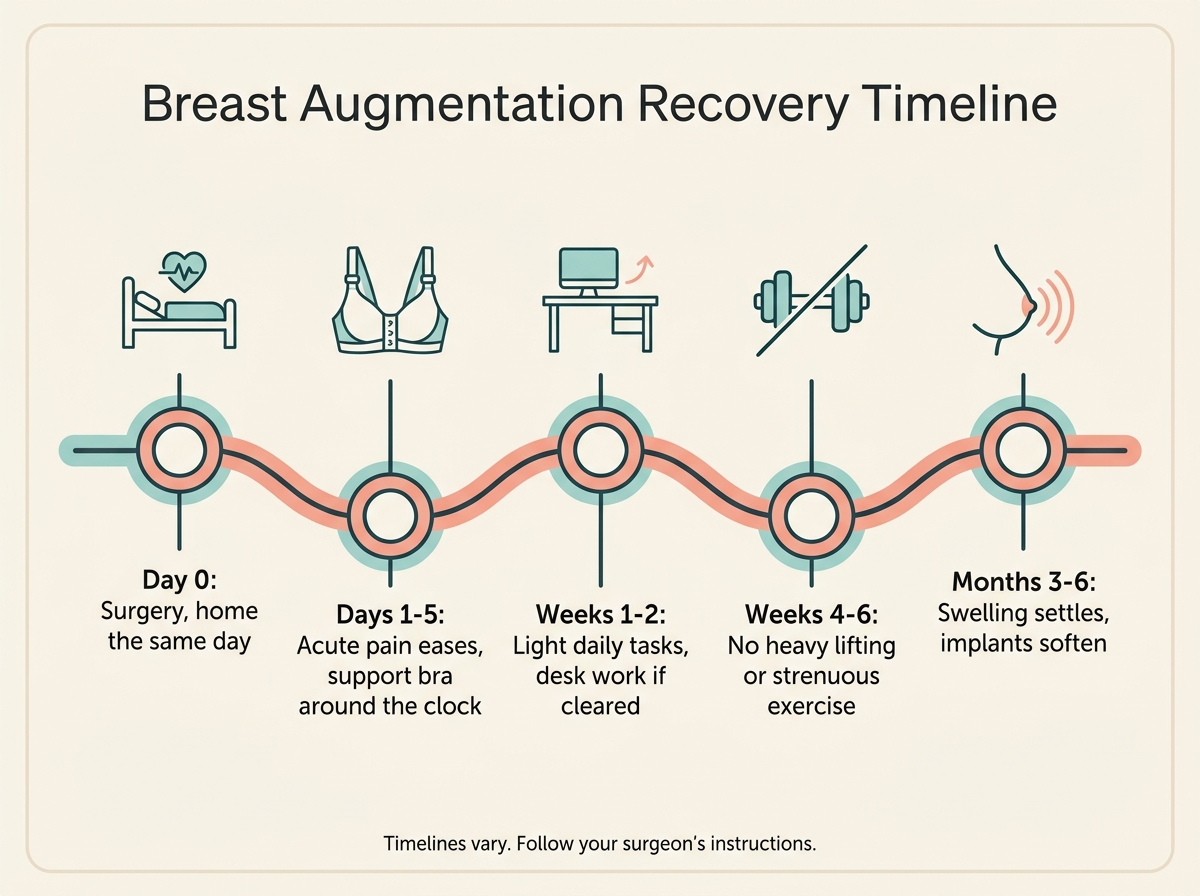
A typical timeline, which your surgeon will adjust:
- Days 1 to 5: rest, prescribed pain relief, no driving on opioids; someone should stay with you the first night.
- Weeks 1 to 2: light activity and desk work are often possible once your surgeon clears you.
- Weeks 4 to 6: many surgeons ask you to avoid heavy lifting and strenuous exercise until this point.
- Months 3 to 6: swelling resolves and your breast implants settle into their final position.
Call your surgeon straight away if you notice fever, spreading redness, sudden swelling on one side, severe or worsening pain, or a wound that opens. Those are red flags.
How should I prepare for the procedure?
Preparation starts weeks before surgery day. Your surgeon will take a full medical history, may order a baseline mammogram if you are over 40, and will tell you which medications to pause. Blood thinners, aspirin, ibuprofen and some herbal supplements raise bleeding risk. Smokers are usually asked to stop several weeks before and after the procedure, because nicotine slows healing.
Practical steps that make the first week easier:
- Arrange a driver and a helper for the first 24 to 48 hours
- Fill prescriptions and buy front-closing tops in advance
- Book time off work: about a week for desk jobs, longer for physical work
If part of your motivation comes from what you see online, read how beauty ideals spread through social media before committing to a permanent change. Cosmetic surgery should fit your own goals rather than a filtered feed.
What should I ask a board-certified plastic surgeon?
Credentials come first. In the US, look for certification by the American Board of Plastic Surgery and confirm the surgery takes place in an accredited surgical facility. Then bring this list to the consultation:
- How many breast augmentations do you perform each year, and what is your revision rate?
- Which implant type, size and placement (over or under the muscle) do you recommend for my breast tissue, and why?
- What does your written quote include, and what happens to the cost if I need a revision?
- How will you screen for BIA-ALCL and silent rupture over the years?
- Can I see before-and-after photos of patients with a similar body type?
A surgeon who welcomes these questions is a good sign. One who rushes past them is a reason for a second opinion. Cosmetic requests are often shaped by trends, as the debate over the so-called chopped chin shows, and a careful surgeon will tell you when a request is not in your interest.
Key takeaways before you decide
- Budget for the whole procedure, including anesthesia and facility fees, plus at least one future revision.
- Silicone implants need routine imaging; saline implants do not, but they feel firmer.
- Full activity returns after roughly six weeks, and humour helps: the knee surgery meme exists for a reason.
- Pick your surgeon for credentials and honesty; the lowest quote is rarely the best one.