
Searching for Connections answers today usually means one of two things. Either you are stuck on a category and want a nudge, or you have run out of mistakes and simply want to know what the puzzle was about. This page does not post a fresh solution every morning. Instead, it shows you where the official NYT Connections hints and answers are published each day, how the Connections game works and which habits get you to the answers on your own more often than not.
What the NYT Connections game is
Connections is a daily word game from The New York Times. It launched in June 2023 and is edited by Wyna Liu, who also works on the NYT crossword. It has since become the second most played title in NYT Games, behind Wordle.
The idea is simple. You get 16 words and have to sort them into four groups of four. Every group shares a hidden category: things that are red, words before “ball”, famous Steves. You do not know the groups in advance. You only see the tiles.
How today’s NYT Connections puzzle works
Before you look for the answers for today, it helps to know the rules that shape every board:
- 16 tiles, four groups, and each word belongs to exactly one of them.
- Four mistakes are allowed. On the fifth wrong guess the round ends and the solution appears.
- A guess with three correct tiles shows “one away”. Two correct tiles get no feedback.
- The categories are colour-coded by difficulty once you find them.
- A new NYT Connections puzzle appears at midnight in your local time zone, seven days a week.
| Colour | Difficulty | Typical category |
|---|---|---|
| Yellow | Easiest | Plain synonyms or obvious sets (types of pasta) |
| Green | Medium | Slightly less common sets (things with keys) |
| Blue | Hard | Trivia or niche knowledge (NBA team nicknames) |
| Purple | Hardest | Wordplay, hidden words, homophones, “___ fish” |
The colours stay hidden while you are playing and appear only after you complete a group, which is why so many people look up Connections hints for the purple one.
Where to find today’s Connections answers and hints
The safest source is the game itself. The official puzzle lives on the NYT Games Connections page, and it is free to play in the browser or in the NYT Games app. Once a round is over, it shows all four groups with every word in them.
For help while you are still playing, The New York Times publishes a daily column called the Connections Companion. It goes up in the Games section shortly after each reset with Connections hints for all four groups, a difficulty rating out of 5 from the paper’s test solvers and, at the bottom, the complete answers. Puzzle #1198, for example, was rated 2.2 out of 5.
Beyond the NYT, a handful of sites post today’s NYT Connections hints and answers within minutes of midnight. Tom’s Guide, TechRadar and NME are the most consistent. Most of them layer the page the same way: category clues first, then the first word of each group, then the full Connections hints and answers for the day below. Scroll carefully if you only want a hint.

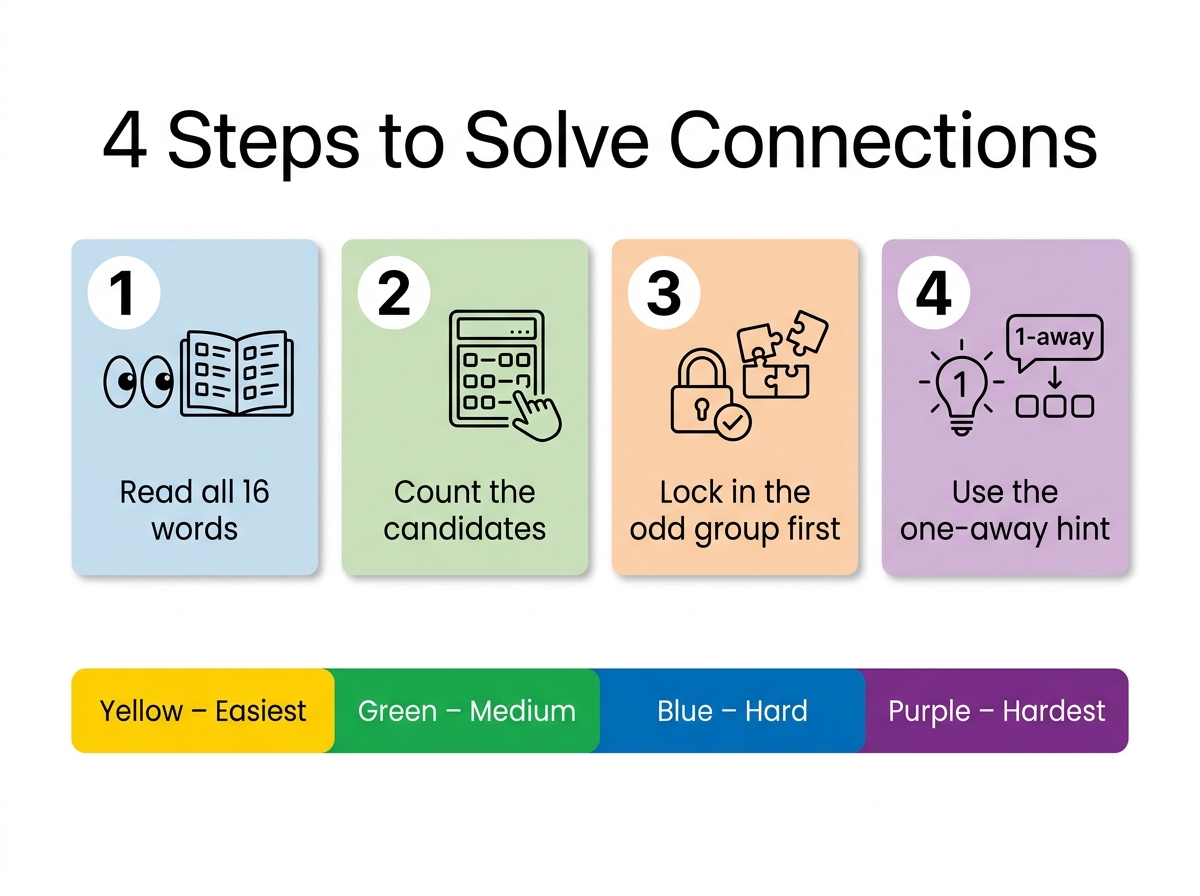
Four steps that crack most boards
Looking up the solution is quick. Working it out yourself is more fun, and after a few weeks you will need the hints far less. Here are the steps regular players use to solve the board:
Step 1: Read all 16 tiles before you tap anything
The board is built so that the first four tiles you notice form a trap. Read everything, out loud if it helps, and note words that can be verbs and nouns at once; those usually sit in the harder groups.
Step 2: Count the candidates for each theme
If six tiles look like “types of bread”, the puzzle wants you to notice that two of them belong elsewhere. A theme with exactly four candidates is probably real. A theme with five or more is a red herring until you have removed the extras.
Step 3: Lock in the odd category first
Counter-intuitive, but it works. When you spot a purple-style connection (hidden words, missing letters, homophones), submit it before the easy groups. Clearing the strange tiles reduces the noise for everything else.
Step 4: Treat “one away” as data
Three out of four correct means one tile is wrong. Swap out the word that could also fit another theme, never the one with a single possible use. Down to your last mistake? The remaining eight tiles are only two groups, so pick the one you are surer about.
Trap categories that catch everyone
Some patterns show up again and again. Once you know them, they stop being traps:
- Hidden words: KINGDOM, SWALLOW and CANDLE all contain animals or body parts.
- Missing letters: tiles that become something new when you add a letter at the start or end.
- Homophones and sound-alikes: KNIGHT, NIGHT and NITE are one theme in disguise.
- “___ ball” and “fire ___”: fill-in-the-blank groups where the shared word is missing.
- Fake sets: four colours, four compass points or four planets that are spread across other groups.
- Proper nouns hiding as common words: JORDAN, PARIS and CHASE can be places, people or brands.
If you enjoy this kind of pattern-spotting, you may also like our look at why mobile games work as a mindfulness tool.
A worked example: puzzle #1198
To see the strategy in action, here is a real board. The NYT Connections puzzle for 21 September 2026 (#1198) used these 16 tiles:
BEET, BRAH, CAPTURE, CASTLE, CHECK, CHOP, CHUM, COMPOSE, DRAFTS, FLY, MATE, SENT, SPAM, SPINNER, VIVA, WORM
Reading the whole board first, most players spot the email buttons quickly: COMPOSE, DRAFTS, SENT and SPAM. That is yellow. CHUM, FLY, SPINNER and WORM all relate to fishing, which gives you green.
The remaining eight tiles are where step 3 pays off. CAPTURE, CASTLE, CHECK and MATE are chess verbs, so blue is done. What is left is BEET, BRAH, CHOP and VIVA. None of them belong together as English words. They are the starts of composers’ names: Beethoven, Brahms, Chopin and Vivaldi. A classic purple group, and CHOP was placed near CHECK and CASTLE to tempt you into a fake set.
| Group | Theme | Tiles |
|---|---|---|
| Yellow | Email buttons | COMPOSE, DRAFTS, SENT, SPAM |
| Green | Ways to attract fish | CHUM, FLY, SPINNER, WORM |
| Blue | Chess verbs | CAPTURE, CASTLE, CHECK, MATE |
| Purple | Starts of composers’ names | BEET, BRAH, CHOP, VIVA |
Frequently asked questions
What time does the new Connections puzzle come out?
At midnight in your local time zone. If your phone is set to another region, the reset follows that region’s clock, and so do the Connections answers for that day.
How many mistakes can you make?
Four. The fifth wrong guess ends the round, and the answers for today are shown on screen.
Can you play past Connections puzzles?
Yes. The New York Times offers an archive of earlier boards to NYT Games subscribers, and several third-party sites keep lists of previous NYT Connections answers for practice.
Is NYT Connections free to play?
The daily puzzle is free on the website and in the app. The archive and some extras need a Games or All Access subscription.
Are there other games like Connections?
Plenty. Wordle, Strands and the Mini Crossword are the obvious ones inside NYT Games. Outside it, browser collections such as Unblocked Games 6x host dozens of word and logic titles you can open from any school or office network.
Is it better to look up the answers or keep guessing?
If you care about your streak, a hint beats a blind guess. Check the clues in the Companion column, solve the groups you can and only read the full solution when you have one mistake left. And if you want to wind down after a tough board, our printable Christmas coloring pages are a low-effort way to switch off.
Bookmark the official page, read the whole board before your first guess and treat every set of five as a warning sign. Do that for a week and “Connections answers today” becomes a search you make far less often.