
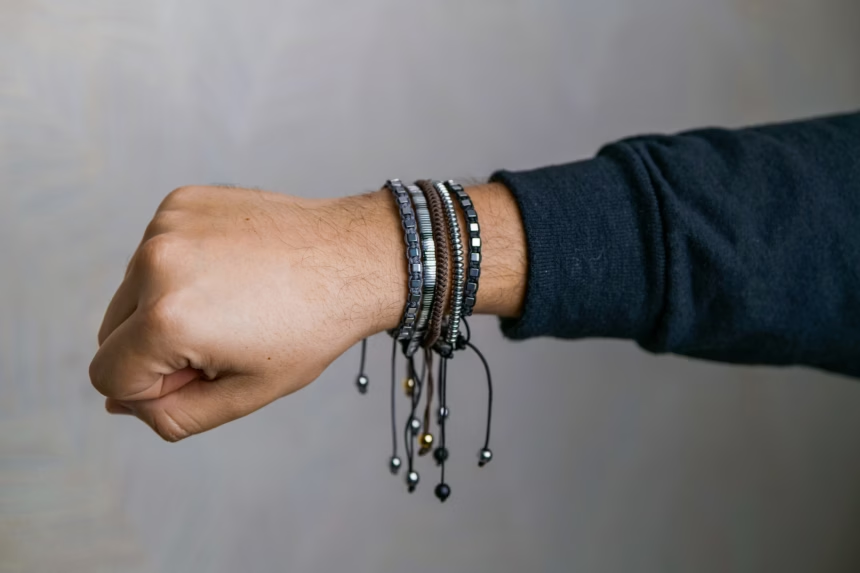
For years considered an almost exclusively feminine accessory, the men’s bracelet has taken center stage. Now the question is no longer “can you?” but “how do you do it well?”
There was a precise moment when something changed in men’s aesthetics. It’s hard to say exactly when — perhaps with Harry Styles taking the stage in pearl necklaces and stacked bracelets, perhaps with the runways starting to treat men as subjects fully worthy of attention to detail — but the result is clear: the men’s bracelet is no longer an aesthetic whim nor a transgressive gesture. It is simply part of the wardrobe.
The challenge, if anything, is figuring out how to use it. Because the wrong bracelet in the wrong context isn’t worse than no bracelet: it’s worse. This guide is meant for exactly that.
First things first: understanding the types of bracelet
Not all bracelets speak the same language. Knowing the main types helps you make informed choices instead of relying on instinct — which often leads to excess or to unwarranted restraint.
The steel or silver bracelet is the most versatile and durable version. A steel bracelet is a classic that never goes out of style, perfect for the office or an elegant evening. Clean, sturdy, neutral: it pairs with almost anything without requiring too much thought.
The leather bracelet — whether braided or with a metal clasp — carries a more casual, earthy energy. It is the natural companion of denim, skate shoes, weekend looks. It has less versatility than steel but more character.
The chain bracelet is the most declarative piece. Chain bracelets are a timeless classic that reinvents itself with ever bolder links and substantial sizes, a symbol of strength and connection, offered in various finishes from gold to silver, often combined for a striking two-tone effect. It is the bracelet that gets noticed, that takes up space, that says something specific about the person wearing it.
The bracelet with stones or natural elements — wood, onyx, agate, lava — belongs to the ethnic and boho tradition. It has a more spiritual and informal soul, and it is hard to make it coexist with formal contexts without looking out of place.
The rigid bangle — a thin band of metal that slides over the wrist — is the most minimalist and at the same time most architectural bracelet. Men’s bracelets are following the direction of minimalism, with clean textures, worked steel and combinations of cord and leather, focusing on subtle layering, mixing metals and geometric shapes for an elegant, modern effect.
Casual looks: the freest territory
The casual look is where the men’s bracelet expresses itself with the greatest freedom. Jeans, t-shirt, open shirt, sneakers — everything accepts an accessory on the wrist without needing any justification.
With a denim outfit, contrast works better than consistency. The ideal is to pair a total-denim outfit with metallic accessories such as necklaces, bracelets and rings, for a wow effect.
A steel bracelet or a silver chain over raw fabric creates that visual tension between soft and rigid that makes the look interesting.
With a white or black t-shirt — the workhorses of any man’s wardrobe — a braided leather bracelet or a single steel bangle is all you need. White amplifies any metallic jewelry, so fewer pieces with more quality always beats many mediocre ones.
With an open linen, flannel or striped shirt, the ethnic or natural-stone bracelet finds its natural dimension: relaxed, warm, authentic. It’s the kind of look where a wooden bracelet or one with volcanic-stone beads doesn’t seem out of place — on the contrary, it contributes to the idea of a man with a defined, conscious style.
Smart casual looks: the challenge of balance
Smart casual is the most difficult context for the bracelet — and also the one where you can make the most interesting choices. A blazer without a tie, a shirt with an open collar, chinos or structured trousers: it’s the dress code of the important aperitivo, the creative meeting, the informal dinner among adults.
Here the bracelet must be present but not loud. A single thin silver or gold bangle on the wrist opposite the watch is the most elegant solution: it adds without distracting. A steel bracelet with minimal work — fine links, brushed texture — works the same way.
The opposite-wrist rule almost always applies: bracelet and watch on the same wrist create visual confusion and, above all, scratch each other. Watch on one side, bracelet on the other — simple and effective.
To be avoided in this context: bracelets with big stones, those with dangling charms, heavy chains that look straight out of a hip-hop video. Not because they’re ugly — in different contexts they work perfectly well — but because they communicate something incompatible with the smart-casual register.
Formal looks: less is more, always
Suit, shirt with a collar and — possibly — a tie. The formal context is the one that tolerates bracelets least, but that doesn’t mean they have to be absent.
A thin gold or silver bracelet — almost imperceptible — glimpsed just below the shirt cuff is a choice few consciously notice but which contributes to that sense of attention to detail that distinguishes an elegant man from one who is merely well dressed.
Bracelets in silver, steel or titanium captivate with their purity. On their own or paired with a watch, they perfectly complete a city-chic outfit.
Everything else — chains, leather bracelets, pieces with decorative elements — is better left at home or moved to the weekend. The formal context is not the place to experiment.
Layering: how to do it without looking like a flea market
Stacking several bracelets on the same wrist — or spreading them across both — is one of the strongest trends of recent years in the world of men’s jewelry. Doing it well requires a few rules.
Rule 1: one lead, two supporting acts. One star bracelet — the chain, the wide bangle, the piece with character — and two thinner, neutral pieces that frame it. Not three stars together, otherwise none of them gets read.
Rule 2: metal consistency. Mixing gold and silver can work, but it requires confidence. For those approaching layering for the first time, it’s better to stay in the same metallic tone: all silver, all steel, all gold. Thin, stackable bracelets are designed to be worn several at a time, so you can mix and match them to create your own style, made in precious metals or thin leather straps.
Rule 3: alternate the textures. One smooth bracelet, one matte, one braided — varying the surface creates visual depth without requiring elaborate pieces.
Rule 4: the watch wrist stays free. Layering is done on the other wrist, or alternatively you pair a single thin bracelet on the same wrist as the watch, chosen carefully so as not to create conflict.
The bracelet as a language
Men’s jewelry is establishing itself as a genuine style accessory. Whether minimalist, symbolic or bold, they convey a personality, an intention and sometimes even a story.
That’s the point, in the end. A bracelet isn’t just a piece of metal or leather around the wrist. It’s a signal you send out to the world — of style, of taste, of intention. Choosing it with judgment means knowing what you want to communicate. And knowing when not to wear it at all is the same thing.
The men’s wardrobe took decades to accept the idea that a man can attend to details without losing his identity. Today that battle is won. All that’s left is to learn to do it well.